Future of Work
The Death of the SaaS Silo: Why the Future Belongs to the Agnostic Meta Platform
Disconnected tools, locked data and vendor-bound AI are reaching a breaking point. The next era belongs to an agnostic meta platform with sovereign data and model-independent intelligence.
Drafted with Agentic support and reviewed by people.
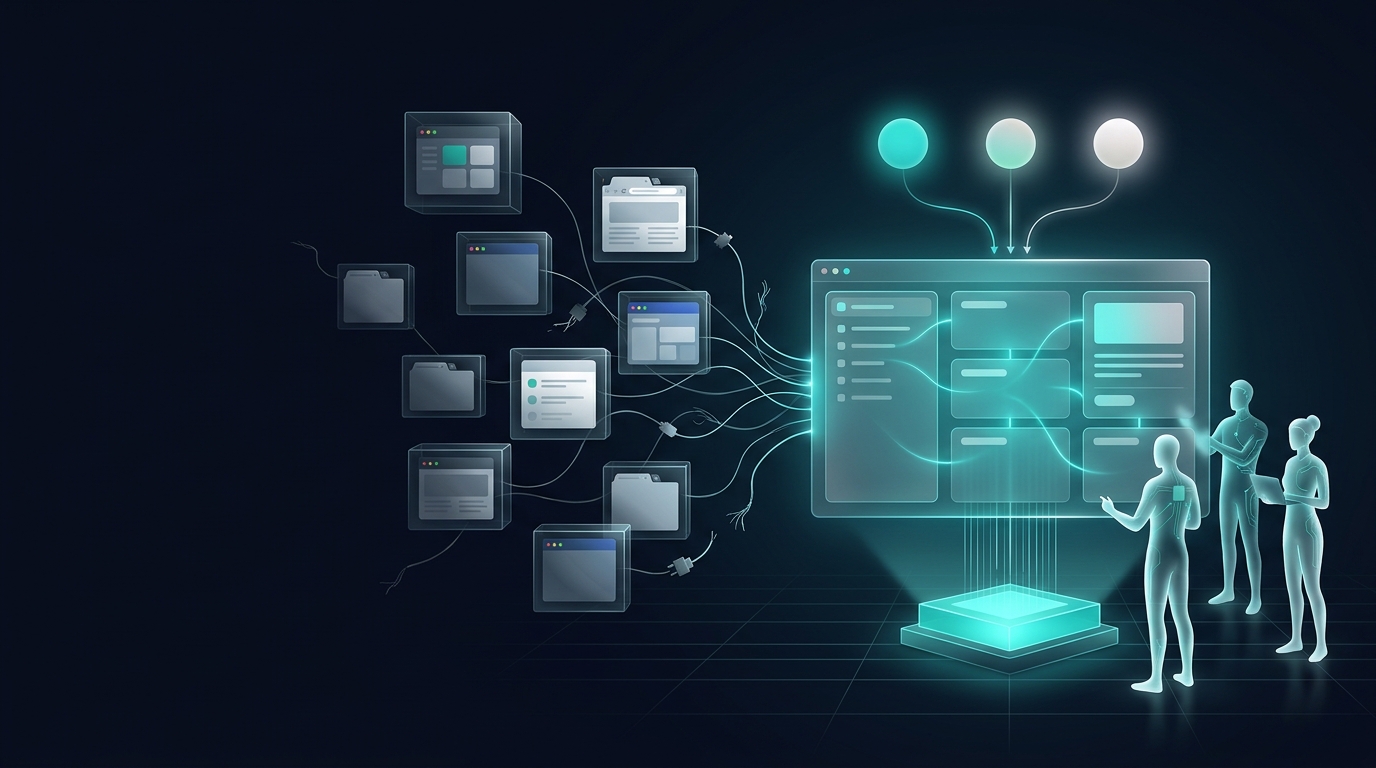
For the past decade, the software industry ran on a simple blueprint: build a specialised cloud application, lock user data inside a proprietary database, charge a recurring per-seat monthly subscription, and build a moat around the ecosystem.
It worked, until it didn't.
Today, enterprise productivity and workflow environments are reaching a breaking point. Organisations are drowning in a sea of disconnected tools, fragmenting their operational context across dozens of browser tabs, and paying a steep operational tax to keep everything loosely synced. As artificial intelligence sweeps through the software landscape, legacy vendors are doubling down on walled gardens, forcing users into vendor-specific AI models and locked-down data ecosystems.
A fundamental structural shift is underway. We are witnessing the end of the traditional SaaS silo and the rise of the agnostic meta platform: an architecture that decouples user interface, agentic intelligence and data storage into a sovereign, model-independent ecosystem.
The modern tech stack: a duct-taped nightmare
Ask any modern knowledge worker or operations manager to show you their daily workflow, and you will see a frantic choreography of context switching.
You manage tasks in Monday.com, design graphics in Canva, store notes in Notion, trace CRM pipelines in HubSpot or Twenty, and coordinate communication across Slack and email. To make these systems talk to one another, companies construct fragile webs of automation using integration platforms like Zapier or Make.
This isn't an ecosystem. It's a duct-taped tech stack.
Every app boundary introduces data friction, sync latency and schema mismatches. When a task status changes in your project management board, it requires an API call, a webhook trigger and a secondary database write to reflect that change in your sales CRM or team chat. When APIs change or webhooks fail, context breaks.
More critically, this fragmentation forces knowledge workers to act as human data routers, spending hours manually copying summary notes from one interface into another just so their tools stay aligned.
The illusion of "AI features" and the vendor lock-in trap
To combat user fatigue, major SaaS incumbents, from graphic suites to project management platforms, are aggressively embedding AI features into their existing software.
These implementations reveal a strategic trap: AI silos.
When a legacy platform adds an AI assistant, it locks you into its chosen vendor model and its specific data boundary. A project management tool's AI only understands the data stored within that tool's database tables. A design suite's AI generation tools operate strictly inside its own editor. If you want an intelligent agent to analyse a design asset alongside your quarterly sales pipeline and project schedule, traditional SaaS platforms hit a hard wall. They cannot see across the fence.
Furthermore, tying an entire operational workflow to a single model provider creates rapid obsolescence. Model capabilities shift month by month. A model that excels at reasoning today might be surpassed by a specialised open-source model tomorrow. Being trapped in a SaaS vendor's rigid AI architecture means you are bound to its chosen provider, its rate limits and its privacy policies.
The paradigm shift: sovereign data and agnostic execution
The next generation of software rejects the premise that your software provider should own your database or dictate your intelligence engine. Out of the chaos of the duct-taped tech stack emerges the agnostic meta platform.
This new architectural paradigm is built on three core pillars.
1. Independent and sovereign data storage
Rather than partitioning data into fifty proprietary cloud schemas, the meta platform relies on an independent, unified database layer owned entirely by the user or organisation, using sovereign SQLite/D1 edge instances, Postgres or object storage. Whether it is a CRM contact, a project task, a financial forecast or a chat transcript, the data lives in a unified, accessible state. The interface becomes a lens over your data, not a lockbox holding it hostage.
2. Agnostic multi-model routing
Intelligence should be a dynamic utility, not a static feature. An agnostic meta platform sits above individual model providers. Need deep logical reasoning for a complex financial analysis? Route the prompt to a leading reasoning model. Need fast, cost-effective context processing for live memory search? Route it to a lightweight, low-latency model. Need specialised code generation? Route it to a self-hosted open-source model. The platform remains constant, while the intelligence engine adapts dynamically to the best model for the job.
3. The multi-agent orchestration layer
Instead of static app-bound buttons, the meta platform introduces background agentic workers that operate across your entire workspace. Agents don't just output text in an isolated chat box. They possess contextual memory of your projects, track task dependencies across channels, and trigger actions natively across integrated APIs.
What this means for the future of work
The rise of the meta platform represents a transition from software as a collection of isolated tools to software as an operating system for work.
When your data storage is sovereign and your AI layer is agnostic:
- Context loss disappears. An AI agent reviewing a project risk can simultaneously pull real-time CRM updates, inspect board cards and review recent chat messages without manual exports or multi-app tab switching.
- Vendor lock-in vanishes. If a SaaS provider raises prices or deprecates a crucial feature, your underlying business memory and operational data remain intact and accessible in your sovereign database layer.
- Cost and performance are optimised. Instead of paying per-seat markups on basic wrapper features, organisations leverage direct edge execution and API routing, keeping operational costs lean while retaining control over their infrastructure.
The way forward
The era of accepting bloated, fragmented, single-purpose SaaS subscriptions is coming to an end. Users no longer want a dozen different AI sidebars competing for attention across a dozen open browser tabs.
They want a unified meta space: a sovereign environment where data is independent, interfaces are flexible, and intelligence is completely agnostic. The platforms that embrace this decoupled, agent-driven future will define the next decade of enterprise productivity.
Where SynAgentics and Meta Space fit
This is the vision and thesis behind SynAgentics and Meta Space. SynAgentics mOS is being built as a single point of orchestration, where people and Agentic Citizens work together in one place, your data stays sovereign and yours, and the best model is chosen for each task rather than the one a vendor prefers. Our belief is simple: Humans + Agentics = Infinite Possibilities.
This is opinion and analysis. It is not a promise of results.
WRITTEN BY
Peter Terrill
Founder and Chief Visioneer
Peter founded SynAgentics after building it to fix his own company's operating problem. He leads the vision for SynAgentic companies where people and Agentic Citizens work as one team.
SynAgentics Meta Space is the Meta Operating System for SynAgentic organisations, where every human role is paired with an Agentic Citizen built to hold it, from idea to $10M+ in revenues and beyond.
Humans + Agentic = Infinite Possibilities.
Governance & Culture
Connect With Us
Copyright © 2026 SynAgentics Pty Ltd. ACN 703 160 463.