Human Transformation
Who Is the Smartest Person in the Room Now? The Orchestrator.
In Evolution 5 knowledge is free to everyone. The advantage now belongs to the orchestrator, and the role is open to anyone willing to learn fast and think big.
Drafted with Agentic support and reviewed by people.
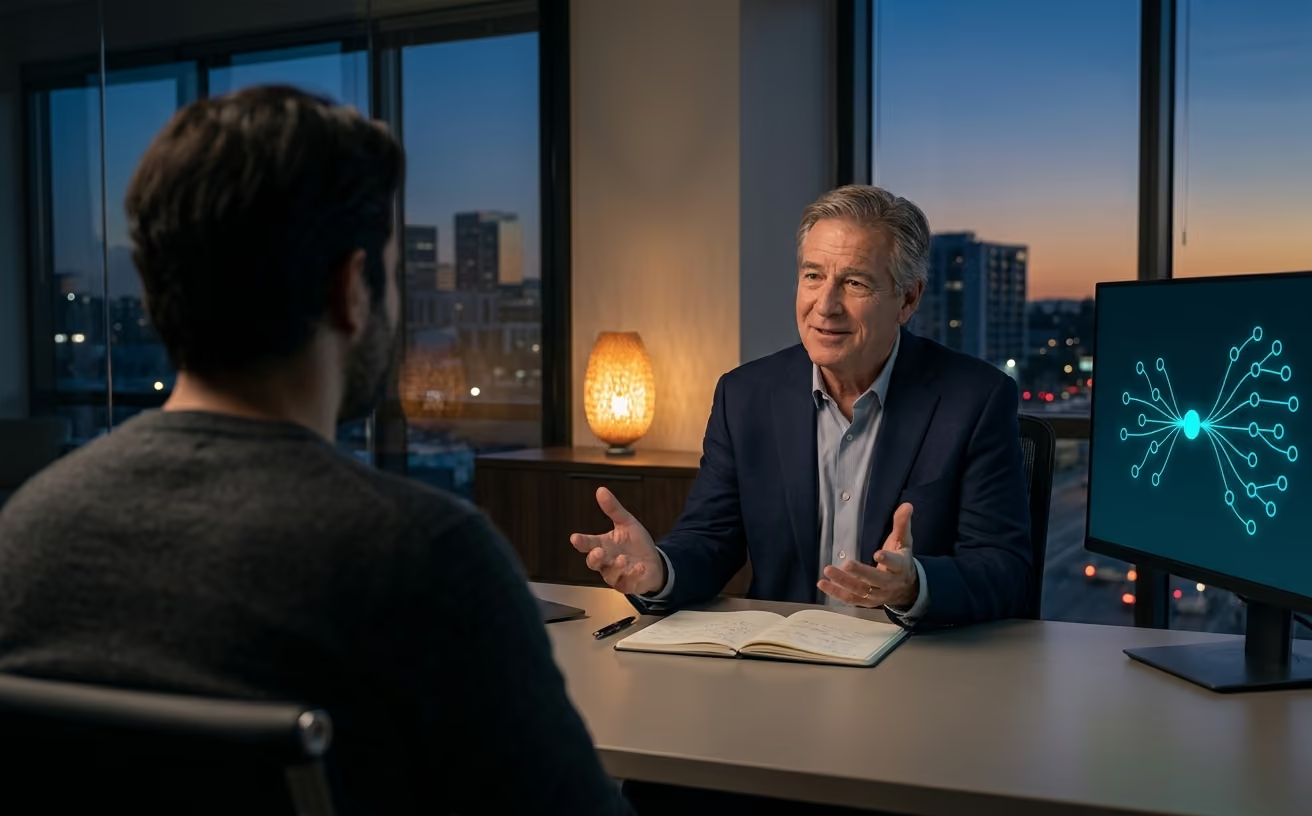
Every organisation has had one. The person everyone turns to when a hard question lands. They have been there the longest, read the most and know exactly who to call. Their knowledge was scarce, so their opinion became the deciding vote.
That is how intelligence worked in Evolution 4. It lived inside people, and access to those people was the advantage. Seniority, experience and connections decided who spoke first and who was believed.
What changed in Evolution 5
Today the whole room is connected to the SynAverse, the universal pool of knowledge we reach through our phones, tablets and laptops. A junior analyst and a veteran director can ask the same question and receive an answer in seconds. What a person knows has stopped being the scarce thing.
When information is free, its value on its own falls close to zero. The value moves to what happens next: which question was asked, what was done with the answer and who heard about it.
Meet the orchestrator
Picasso is often credited with saying that computers are useless because they can only give you answers. Whether or not he said it, the point has never been truer. Answers are cheap. The question is where the value begins.
Here is an illustration, not a case study. Two team members receive the same brief on the same Monday: find out why customers are leaving. The first asks an Agentic Citizen, "Why are customers leaving?" and receives a sensible list of common reasons, the same list any business would get. The second has noticed that cancellations cluster right after the second invoice. She asks her Agentic Citizen to compare those accounts with the ones that stayed, passes the pattern to a Specialist to draft three possible fixes, and reviews the results before lunch.
Same tools. Same access. A very different outcome. The difference was never the information. It was the idea behind the question.
The three skills that matter now
Ideas and seeing. The orchestrator notices what others walk past. An Agentic Citizen can search endlessly, yet it cannot decide what is worth wanting. That direction comes from a person with a vision of where they are going.
Turning information into value. Answers become valuable when they turn into decisions, workflows, offers and plans. This is where human review and judgment sit. Knowing what to keep, what to question and what to discard is the craft, and it is why orchestration and prompt governance matter as much as the tools themselves.
Getting your point of view out. The world is louder than it has ever been, and everyone is competing for the same attention. A sharp insight that never leaves your head helps nobody. The orchestrator turns a point of view into content, conversations and relationships that cut through the noise.
This seat is open to everyone
In Evolution 4 the barriers were easy to see: the right age, the right degree, years of experience and a contact list full of the right names. Those barriers kept many capable people out of the room.
They are no longer the gatekeepers. Age does not decide who becomes the smartest orchestrator in an Evolution 5 room. Neither do education, experience or connections. What decides it now is mindset: the ability to learn fast, to see big and to leverage Agentics.
A founder in their twenties can orchestrate a team of Agentic Citizens and Specialists to do work that once needed a department. So can a leader in their fifties who chooses to learn the tools and trust their own judgment. The access is the same for both. The only question is who decides to step up.
Nobody will hand you the title. You claim it by asking better questions and acting on the answers.
How SynAgentics supports the orchestrator
SynAgentics is built on a simple belief: Humans + Agentics = Infinite Possibilities. In a SynAgentic organisation the human brings the vision, the question and the final review. Agentic Citizens bring the memory, the speed and the execution, and they manage teams of Specialists for specific tasks. SynAgentics mOS gives that team a shared place to work in Meta Space, with institutional memory that keeps growing, so the orchestrator is never starting from zero.
An orchestrator also needs a destination. That is the job of a Meta Vision: the end game, with milestones at one, three and five years, broken into Quarters and 30-day Sprints. A clear destination makes every question sharper and every answer easier to judge.
The question to ask yourself
If knowledge is free, what is your edge? Not what you know, because anyone can look that up. What do you see that others miss, and how fast can you turn it into something valuable and put it in front of the world?
The smartest person in the room is no longer the one with the most answers. It is the one conducting the orchestra, and the seat is open to you. If you want to explore what that looks like for your organisation, a conversation with a SynAgentics Advisor is the place to start.
WRITTEN BY
Peter Terrill
Founder and Chief Visioneer
Peter founded SynAgentics after building it to fix his own company's operating problem. He leads the vision for SynAgentic companies where people and Agentic Citizens work as one team.
SynAgentics mOS is the Meta Operating System for SynAgentic organisations, where every human role is paired with an Agentic Citizen built to hold it, from idea to $10M+ in revenues and beyond.
Humans + Agentic = Infinite Possibilities.
Governance & Culture
Connect With Us
Copyright © 2026 SynAgentics Pty Ltd. ACN 703 160 463.